The new New Zealand Productivity Commission (modelled on its Australian counterpart) is conducting an Inquiry into International Freight Transport Services. The Commission is looking at both aviation and maritime services, including air and sea ports (New Zealand has no land borders).
The Terms of Reference for the Inquiry were released in March 2011 and on 13 July 2011 the Commission released a 78-page Issues Paper with 79 specific questions.
Submissions are now being made available on the Commission's web site. To date those from the aviation industry have included submissions from the Aviation Industry Association, Board of Airline Representatives NZ, New Zealand Air Cargo Council, NZ Airports Association, and Auckland, Wellington and Christchurch airports.
Showing posts with label maritime. Show all posts
Showing posts with label maritime. Show all posts
18 September 2011


04 September 2011
New Zealand Government releases transport policy direction statement
On 31 August 2011 the New Zealand Minister of Transport, Hon. Steven Joyce, released a new 44-page transport policy direction statement, Connecting New Zealand.
In contrast to the previous coalition government's 2008 New Zealand Transport Strategy (see previous post), Connecting New Zealand includes three pages specifically focussed on civil aviation.
Road safety continues to be a major priority. Also featured are the Roads of National Significance, a programme of investment in the road network around New Zealand's three main centres, and major investment in rail.
In contrast to the previous coalition government's 2008 New Zealand Transport Strategy (see previous post), Connecting New Zealand includes three pages specifically focussed on civil aviation.
Road safety continues to be a major priority. Also featured are the Roads of National Significance, a programme of investment in the road network around New Zealand's three main centres, and major investment in rail.
31 May 2011
OECD meeting of transport experts
On 15-16 November 2010 the OECD hosted a meeting of transport experts, including representatives from ICAO, the World Bank, the WTO and IATA, as well as academics, to discuss the development of a services trade restrictiveness index.
A Highlights of Discussions document has been released by the OECD along with presentations and background documents.
A particularly thought provoking paper is that by Kenneth Button from George Mason University on Air Transportation Services: Both a Traded Commodity and a Transactions Cost in Trade.
A Highlights of Discussions document has been released by the OECD along with presentations and background documents.
A particularly thought provoking paper is that by Kenneth Button from George Mason University on Air Transportation Services: Both a Traded Commodity and a Transactions Cost in Trade.
02 April 2011
European Commission publishes its vision for Europe's transport future
On 28 March 2011 the European Commission published a white paper Roadmap to a Single European Transport Area - Towards a competitive and resource efficient transport system.
10 April 2010
Fuel prices through to March 2010
Around nine months ago I posted graphs of the Singapore spot prices converted to New Zealand dollars of aviation jet fuel and residual fuel oil (RFO) used in ships. The updated graphs through to March 2010 that follow illustrate how these spot prices have been changing in recent months and give an indication of how fuel prices in the first decade of the 21st century.
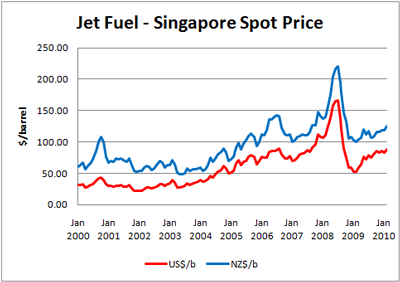


Again I have used monthly data from the Reserve Bank of New Zealand for the foreign exchange rates and from the US Energy Information Administration for the fuel spot prices.
07 February 2010
Pew Center report focuses on potential for aviation and shipping to reduce GHG emissions
In December 2009 the Pew Center on Global Climate Change based in Arlington, Virginia released a 51 page report, Aviation and Maritime Transportation: GHG Mitigation Potential and Challenges written by David McCollum, Gregory Gould and David Greene.
Of particular interest is the graph of the evolution of aircraft energy intensity on page 17. It clearly makes the point that, although better aircraft technology is available, it takes time for airline fleets to be re-equipped.
International air and sea transport emissions after Copenhagen
04 October 2009
US Congress cap and trade bills cover international aviation?
As far as I can tell from a word search, the current versions of the Waxman-Markey (passed by the US House of Representatives) and Kerry-Boxer (being introduced to the US Senate) bills to introduce a cap and trade system, whether by accident or design, would involve a unilateral extension of coverage to include international air and sea transport emissions.
Commenting on this IATA Director General Bisignani, in a speech to the International Aviation Club in Washington DC on 15 September 2009, said:
"The challenge is to align governments on economic measures through ICAO. The way that we are heading now, a flight from New York to London could be triple taxed considering the 2012 inclusion of aviation in the European ETS; the UK Air Passenger Duty which will collect GBP 2.7 billion by 2011; and US cap-and-trade proposals in the Waxman-Markey Bill. This is nonsense. The EU ETS is unilateral, extra-territorial and illegal. The US must be among the countries fighting it, shouting even louder."
Commenting on this IATA Director General Bisignani, in a speech to the International Aviation Club in Washington DC on 15 September 2009, said:
"The challenge is to align governments on economic measures through ICAO. The way that we are heading now, a flight from New York to London could be triple taxed considering the 2012 inclusion of aviation in the European ETS; the UK Air Passenger Duty which will collect GBP 2.7 billion by 2011; and US cap-and-trade proposals in the Waxman-Markey Bill. This is nonsense. The EU ETS is unilateral, extra-territorial and illegal. The US must be among the countries fighting it, shouting even louder."
European Union proposals on international bunker fuels for climate change negotiations
On 27 September 2009 Reuters carried a story on European Union proposals on how to treat emissions caused by international bunker fuels in the context of the climate change negotiations.
The phrase "international bunker fuels" covers both the international maritime and aviation. Related emissions are not covered by the Kyoto Protocol, in part because no consensus had been reach on how they would be allocated to individual countries.
The phrase "international bunker fuels" covers both the international maritime and aviation. Related emissions are not covered by the Kyoto Protocol, in part because no consensus had been reach on how they would be allocated to individual countries.
08 August 2009
Air transport and the NZ Consumers Price Index
Buried deep in the revamped Statistics New Zealand web site one can find using Infoshare NEW data series for international and domestic air transport prices, together with road, rail and sea passenger transport prices - look under Economic Indicators: Consumers Price Index: CPI Classes for New Zealand.
I am not sure precisely what of the many thousands of tariffs the statisticians are monitoring to come up with these series. With respect to domestic air travel Price Index News: July 2009 UPDATED does however state:
"The initial impact of a recent new entrant [Jetstar], offering passenger air transport services on several routes within New Zealand, including the main trunk routes between Auckland, Wellington and Christchurch, will be mostly reflected in the CPI for the June 2009 quarter. Domestic air transport prices are collected monthly, for travel the following month. For example, prices collected in mid-May for travel to be taken in mid-June are included in the May month for CPI purposes. As such, approximately two-thirds of the impact of the introduction will be shown in the June 2009 quarter, with the remainder in the September 2009 quarter. Of the domestic routes tracked for the CPI, flights between the three main centres carry between 50 and 60 percent of the expenditure weight of the domestic air transport index."
I am not sure precisely what of the many thousands of tariffs the statisticians are monitoring to come up with these series. With respect to domestic air travel Price Index News: July 2009 UPDATED does however state:
"The initial impact of a recent new entrant [Jetstar], offering passenger air transport services on several routes within New Zealand, including the main trunk routes between Auckland, Wellington and Christchurch, will be mostly reflected in the CPI for the June 2009 quarter. Domestic air transport prices are collected monthly, for travel the following month. For example, prices collected in mid-May for travel to be taken in mid-June are included in the May month for CPI purposes. As such, approximately two-thirds of the impact of the introduction will be shown in the June 2009 quarter, with the remainder in the September 2009 quarter. Of the domestic routes tracked for the CPI, flights between the three main centres carry between 50 and 60 percent of the expenditure weight of the domestic air transport index."
IMO releases report on GHG emissions from shipping
The London-based UN International Maritime Organization (IMO) has released a 287-page Second IMO GHG Study dated 9 April 2009.
"The Study estimated that ships engaged in international trade in 2007 contributed about 2.7 per cent of the world's anthropogenic CO2 emissions and also states that emission reductions are feasible through technical and operational measures as well as through the introduction of market-based reduction mechanisms."
The study was considered by the Maritime Environment Protection Committee (MEPC) of IMO at its 59th Session held on 13-17 July 2009. The first study was dated 2000.
"The Study estimated that ships engaged in international trade in 2007 contributed about 2.7 per cent of the world's anthropogenic CO2 emissions and also states that emission reductions are feasible through technical and operational measures as well as through the introduction of market-based reduction mechanisms."
The study was considered by the Maritime Environment Protection Committee (MEPC) of IMO at its 59th Session held on 13-17 July 2009. The first study was dated 2000.
10 July 2009
Fuel prices bouncing back up
Around six months ago I posted graphs of the Singapore spot prices converted to New Zealand dollars of aviation jet fuel and residual fuel oil (RFO) used in ships. The updated graphs through to June 2009 that follow illustrate how these spot prices have been rising in recent months.


Again I have used monthly data from the Reserve Bank of New Zealand for the foreign exchange rates and from the US Energy Information Administration for the fuel spot prices.
22 March 2009
Lord Turner suggests flight rationing
In early February 2009 the Telegraph, the Daily Mail and the Financial Times Westminster weblog all carried stories reporting that the UK Government's Chairman of the Committee on Climate Change (CCC), Lord Turner, has raised the possibility that in future flying be rationed in order to cut greenhouse gas emissions.
On 1 December 2008 the CCC published its first report on Building a low-carbon economy – the UK’s contribution to tackling climate change. Chapter 8 covers International aviation and shipping.
The CCC is now writing an Aviation Report to be published in December 2009.
On 1 December 2008 the CCC published its first report on Building a low-carbon economy – the UK’s contribution to tackling climate change. Chapter 8 covers International aviation and shipping.
The CCC is now writing an Aviation Report to be published in December 2009.
25 January 2009
Container rates for Asia to Europe hit zero
09 December 2008
The fuel spot price "super spike" collapse
I have continued monitoring the Singapore spot prices of international bunker fuels (jet used in aircraft and residual fuel oil (RFO) used in ships) in US$ and NZ$. The following four graphs show the results for this decade including November 2008 (see previous post for data sources). The second and fourth of the graphs are indexed with a base on 100 in January 2000.


 The term "super spike" in relation to oil price movements was reported on 21 May 2008 by the International Herald Tribune to have been used by a Goldman Sachs analyst, Arjun Murti, who was predicting that the price of oil could go as high as US$200 and would stay above US$100 into 2011. Bloomberg reported on 6 May 2008 that Murti first used the term "super spike" in March 2005.
Murti's latest views on the price of oil were covered in a 12 December 2008 post NEW on the Alphaville weblog from the Financial Times.


 The term "super spike" in relation to oil price movements was reported on 21 May 2008 by the International Herald Tribune to have been used by a Goldman Sachs analyst, Arjun Murti, who was predicting that the price of oil could go as high as US$200 and would stay above US$100 into 2011. Bloomberg reported on 6 May 2008 that Murti first used the term "super spike" in March 2005.
Murti's latest views on the price of oil were covered in a 12 December 2008 post NEW on the Alphaville weblog from the Financial Times.
30 November 2008
The Box
The BBC is following a shipping container around the world for a year and has a page for The Box complete with related stories and GPS tracking of its location.
The container started out in the UK with a shipment of Scotch whisky bound for China and is now headed for the USA full of consumer goods (HT to Transport Blog).
The container started out in the UK with a shipment of Scotch whisky bound for China and is now headed for the USA full of consumer goods (HT to Transport Blog).
Rise in piracy
This year has seen increasing news reports of piracy, particularly off the coast of Somalia.
An excellent source of data for this growing problem is the International Chamber of Commerce's International Maritime Bureau which operates a Piracy Reporting Centre based in Malaysia. The Centre maintains a live piracy map of all such incidents around the world.
An excellent source of data for this growing problem is the International Chamber of Commerce's International Maritime Bureau which operates a Piracy Reporting Centre based in Malaysia. The Centre maintains a live piracy map of all such incidents around the world.
06 November 2008
More direct transport links between Taiwan and the Mainland
On 4 November 2008 China Daily reported on the further opening of transport links between Taiwan and the Chinese Mainland following the signing of agreements between the mainland's Association for Relations Across the Taiwan Straits and the Straits Exchange Foundation (see previous post).
The permitted number of charter flights will be tripled to 108 per week and will be able to operate every day of the week (an agreement signed earlier this year permitted operations on only four days per week). New direct air routes will be introduced saving fuel and emissions as current flights are required to transit Hong Kong air space. Sixty direct cargo flights per month will also be possible.
Direct shipping links will be opened.
On 5 November 2008 Taiwan News carried a story on the negative impact the move is likely to have on Hong Kong.
The permitted number of charter flights will be tripled to 108 per week and will be able to operate every day of the week (an agreement signed earlier this year permitted operations on only four days per week). New direct air routes will be introduced saving fuel and emissions as current flights are required to transit Hong Kong air space. Sixty direct cargo flights per month will also be possible.
Direct shipping links will be opened.
On 5 November 2008 Taiwan News carried a story on the negative impact the move is likely to have on Hong Kong.
25 October 2008
The Baltic Dry Index sinks
On 24 October 2008 Bloomberg reported that the Baltic Dry Index (BDI) has fallen 90% since May 2008 (see chart). On 16 October 2008 the Financial Times carried a story on this drop.
The BDI measures the cost of chartering large bulk ships and is regarded as a leading indicator of global economic activity. Back on 24 October 2003 an article by Daniel Gross in Slate described it as the best economic indicator you've never heard of.
With such developments as this and the fall in the price of oil maybe the world is getting smaller again (see previous post).
The BDI measures the cost of chartering large bulk ships and is regarded as a leading indicator of global economic activity. Back on 24 October 2003 an article by Daniel Gross in Slate described it as the best economic indicator you've never heard of.
With such developments as this and the fall in the price of oil maybe the world is getting smaller again (see previous post).
Gongoozling
An article published by The Economist on 18 September 2008 increased my vocabulary. I had never come across the word Gongoozler before. It seems that it is the canal equivalent of a train or plane spotter.
These days what is left of the UK canal network is maintained by British Waterways. I have been to the National Waterways Museum in Gloucester.
These days what is left of the UK canal network is maintained by British Waterways. I have been to the National Waterways Museum in Gloucester.
Subscribe to:
Posts (Atom)


 Posts
Posts

