25 April 2010
Russia questions status of Austrian Airlines
On 24 March 2010 Austrian Times carried a report that the Russian Government was questioning the nationality of Austrian Airlines following involvement by Lufthansa and that this issue has been the subject of ongoing talks.


Comprehensive article on air services liberalisation published in Airline Business
On 22 April 2010 FlightGlobal published a comprehensive article from Airline Business by David Knibb entitled Liberalisation: Breaking the bilateral web on progress on air services liberalisation.
The article would have benefited by also examining the research work done by the World Trade Organization in this area.
Unfortunately the Knibb article is spoilt by some factual inaccuracies concerning developments in the South West Pacific.
"MALIAT remains open for others to join, but none have."
Actually, although they are not major, four other countries have joined: the Cook Islands, Samoa and Tonga and Mongolia (cargo only)(see http://www.maliat.govt.nz/country/index.shtml).
"A Pacific Islands Air Services Agreement and Single Caribbean Sky are still only proposals."
Actually the Pacific Islands Air Services Agreement (PIASA) has been in force since 13 October 2007 and this month Australia and New Zealand became eligible to join (see http://www.forumsec.org/pages.cfm/economic-governance/economic-growth-work-programme/aviation-1/aviation.html UPDATED).
I do not claim detailed knowledge of the current situation in the Caribbean but I am also left wondering what the relationship of the article reference to "Single Caribbean Sky" is to the agreement that came into force in 1998 (see previous post).
"Open skies" policy debated in Sri Lanka
On 18 April 2010 the Sunday Times from Columbo reported comments by the Sri Lankan President on the impact the previous government's "open skies" policy was having on Sri Lankan airlines, SriLankan and Mihan Air. The article suggests that there is a need to balance the interests of the airline industry with those of the tourism industry.
Israel reaches "open skies" agreement with the United States
On 23 April 2010 the US Secretary for Transportation, Ray LaHood, announced the negotiation of an "open skies" agreement between the United States and Israel. Israel becomes the USA's 97th "open skies" partner.
A slightly out of date list of those countries that now have "open skies" relationships with the USA, arranged by geographic region, is available here on the Department of Transportation web site. The US Department of State list, which is in chronological order, is more up to date.
It has got to the point where a more interesting list would be of the countries that do not have "open skies" agreements with the United States. Notable absentees include Brazil, China, Colombia, Egypt, Mexico, Russia, Saudi Arabia, South Africa, Turkey and Vietnam. A 13 April 2010 article in BTNonline.com quotes John Byerly, State's Deputy Assistant Secretary for Transportation Affairs, commenting on the next negotiating priorities for the United States.
21 April 2010
The impact on aviation of the volcanic eruption in Iceland
I have been trying to monitor the impact on aviation of the 2010 eruptions of Eyjafjallajökull in Iceland and the virtually unprecedented shutdown of European airspace. This post links to some of the resources that I have been using. Some of the web sites are enjoying unprecedented popularity and their performance is suffering accordingly. I have also found Twitter (I use the free program TweetDeck) useful - search for #ashtag.
The eruption itself can be seen on three webcams set up in Iceland. Of course, this is daylight and weather dependent.
Maps with live air traffic over Europe (the advice is use any web browser except MS Internet Explorer) can be seen at:
The official news about airspace availability can be seen on the web sites of:
- Eurocontrol
- NATS - covering the UK
Specific information on the ash cloud is released by the UK Met Office Volcanic Ash Advisory Centre.
On 19 April 2010 IATA commented on the situation and released an assessment that the likely daily revenue loss to airlines of being grounded would be in excess of US$200m per day. ACI Europe and CANSO have made similar estimates for the daily financial impact on airports and air traffic control providers respectively.
Because of the uncertainty about the event, scenario analysis provides useful way of thinking about the impacts. A series of articles from Reuters by Peter Apps are the best I have seen so far:
- Scenarios - Potential scenarios for volcano gas cloud crisis - 18 April 2010
- Scenarios - How could Europe volcano crisis play out? - 19 April 2010
- Scenarios: What if volcano disruption last weeks, months? - 20 April 2010
This truly is a "Black Swan" event (see previous post) and may prove to be a real test of concern about safety versus concern about the economic survival of the European airline industry.
10 April 2010
Fuel prices through to March 2010
Around nine months ago I posted graphs of the Singapore spot prices converted to New Zealand dollars of aviation jet fuel and residual fuel oil (RFO) used in ships. The updated graphs through to March 2010 that follow illustrate how these spot prices have been changing in recent months and give an indication of how fuel prices in the first decade of the 21st century.
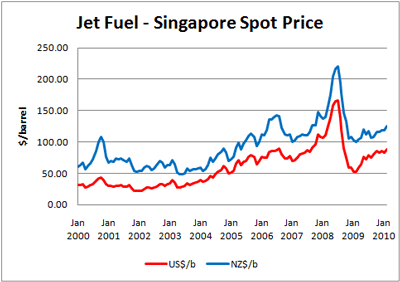


Again I have used monthly data from the Reserve Bank of New Zealand for the foreign exchange rates and from the US Energy Information Administration for the fuel spot prices.
30 March 2010
European Commission completes second stage air transport negotiations with the United States
On 25 March 2010 the outcome of the second stage of the air services negotiations between the European Union and the United States was announced:
Aviation Law Prof Blog made the full texts available in a 25 March 2010 posting.
Eight rounds of negotiations were required to achieve this limited outcome.
Reaction included that from IATA expressing disappointment at the lack of significant progress and from the Association of European Airlines (AEA) who described it as "Realistic, but not visionary." The US Air Transport Association (ATA) took a more positive view.
I cannot help but think that the 13 February 2010 draft decision by the US Department of Transportation to grant anti-trust immunity to the joint business agreement between American Airlines, British Airways and Iberia was a significant factor in achieving a positive outcome (see the Journal of Commerce article dated 15 February 2010). It remains to be seen whether the European Commission also grants approval for this alliance.
Zambia signs "open skies" agreement with the United States
On 17 March 2010 the United States Embassy in Lusaka announced that Zambia and the United States of America had signed an "open skies" agreement the previous day.
14 February 2010
Fiji to continue air services negotiations with the UAE
On 12 February 2010 the Fiji Times reported that air services negotiations between Fiji and the United Arab Emirates would continue at the third ICAO Air Services Negotiation Conference to be held in Jamaica at the end of June (see previous post).
The UAE Foreign Minister has been making a multi-stop visit to the South West Pacific.
Australia expands air services arrangements with China
On 14 February 2010 the Australian Minister for Infrastructure, Hon Anthony Albanese, announced a phased increase in seat capacity (by 70%) and traffic rights in its air services arrangements with China.
No detail is given as to what new points beyond Australia Chinese airlines will be able to operate to but one might speculate that they involve New Zealand.
Australia and UAE agree to a seat capacity increase
On 12 February 2010 the Australian Minister for Infrastructure, Transport, Regional Development and Local Government announced that Australia had agreed a seat capacity increase for air services with the United Arab Emirates. Some of this extra capacity is conditional on UAE carriers serving regional airports in Australia.
Singapore signs new air services agreement with Nepal
The Singapore Ministry of Transport announced on 2 February 2010 that Singapore had signed a new air services agreement with Nepal. The arrangements provide for capacity limited on the basis of service frequency and a limited exchange of fifth freedom rights for passenger services. Traffic rights for cargo services are more open.
India to sign new air services arrangements with Nepal
On 11 February 2010 the Government of India announced that its Cabinet had approved new air services arrangements with Nepal following negotiations held in September 2009. The new arrangements provide for a capacity cap based on the number of seats per week with sub limits for services by Nepali airlines on the routes to Mumbai, Bangalore and Delhi that will be phased out next year.
07 February 2010
UK Department for Transport consulting on regulating air transport
On 10 December 2009 the United Kingdom Department for Transport launched a consultation on regulating air transport. The focus is on the activities of the UK Civil Aviation Authority, in particular its role in consumer protection.
Submissions are due on 11 March 2010.
Pew Center report focuses on potential for aviation and shipping to reduce GHG emissions
In December 2009 the Pew Center on Global Climate Change based in Arlington, Virginia released a 51 page report, Aviation and Maritime Transportation: GHG Mitigation Potential and Challenges written by David McCollum, Gregory Gould and David Greene.
Of particular interest is the graph of the evolution of aircraft energy intensity on page 17. It clearly makes the point that, although better aircraft technology is available, it takes time for airline fleets to be re-equipped.
International air and sea transport emissions after Copenhagen
Australasian tourism leaders determined to lobby against UK Air Passenger Duty increases
On 5 February 2010 the Dominion Post reported comments from Australian and New Zealand tourism industry group leaders who are determined to continue lobbying against increases in UK's Air Passenger Duty (see previous post).
The article notes that the increases have been the subject of correspondence between the New Zealand and UK Prime Ministers, John Key and Gordon Brown, and quotes Key on the issue.
ACCC releases draft determination on BA/QF JSA
On 4 February 2010 the Australian Competition & Consumer Commission released its 65 page draft determination on the application to grant a further five year approval for the Joint Services Agreement (JSA) between British Airways (BA) and Qantas (QF).
The Commission noted that in the last five years competition in the relevant markets has increased. Table 2.1 on page 13 in the draft determination shows how airline market shares in the Australian international air transport market have changed over the last decade with sixth freedom carriers Singapore Airlines (SQ), Emirates Airline (EK) and Cathay Pacific (CX) making significant gains. This needs to be read with care as the market share Qantas subsidiary Jetstar (JQ) is not given next to that of Qantas. The decline in the Qantas group market share has not been as dramatic as it appears at first glance, with the combined market share being 29.8% in 2009 (or did the draft mean 2008?).
In a 5 February 2010 report on the release Steve Creedy in the Australian noted that British Airways will cut its daily Sydney-Singapore-London flights next month but it will continue to fly a daily service via Bangkok.
27 December 2009
UK Committee on Climate Change releases Aviation Report
On 8 December 2009 the UK Committee on Climate Change released a large Aviation Report. The report sets out the Committee’s assessment of options for reducing UK aviation emissions up to 2050.
Continental Airlines and Air New Zealand apply for anti-trust immunity
Continental Airlines (CO) and Air New Zealand (NZ) have applied to the US Department of Transportation for anti-trust immunity (the docket reference is DOT-OST-2009-0340). The application was posted on the official Regulations.gov web site on 14 December 2009.
Continental Airlines joined the Star Alliance on 27 October 2009.
Continental Airlines joined the Star Alliance on 27 October 2009.
Antipodes
I was recently involved in a discussion about the shortest distances between various airports in East Asia and South America. Being on opposite sides of the world, many airport pairs in the two continents cannot be served non stop with existing airliners.
The Boeing B777-200LR (17,395 km range) and Airbus A340-500 (16,700 km range) come close but the economics of ultra long-haul, point-to-point routes means that they struggle to be profitable. Therefore the question arises as to what intermediate points make sense to airlines and travellers. For example, to what extent does Auckland (AKL) make sense as an intermediate point for travel between the two continents?
The Great Circle Mapper web site is a great help in supporting such discussions (see previous post) but also useful is the Antipodes Map web site which identifies the exact opposite side of the world to any point on the globe. The Wikipedia entry for Antipodes has a couple of maps that illustrate this.
The world is not exactly spherical. The distance around the Earth at the equator is 40,075 km. The distance around the Earth through the poles is 40,008 km. Therefore the theoretical maximum great circle distance between any two airports is 20,038 km.
Of course, considerations such as times from alternative airports in the event of an engine failure, prevailing winds, connecting times and visa requirements will also influence airlines and travelers decisions.
The Boeing B777-200LR (17,395 km range) and Airbus A340-500 (16,700 km range) come close but the economics of ultra long-haul, point-to-point routes means that they struggle to be profitable. Therefore the question arises as to what intermediate points make sense to airlines and travellers. For example, to what extent does Auckland (AKL) make sense as an intermediate point for travel between the two continents?
The Great Circle Mapper web site is a great help in supporting such discussions (see previous post) but also useful is the Antipodes Map web site which identifies the exact opposite side of the world to any point on the globe. The Wikipedia entry for Antipodes has a couple of maps that illustrate this.
The world is not exactly spherical. The distance around the Earth at the equator is 40,075 km. The distance around the Earth through the poles is 40,008 km. Therefore the theoretical maximum great circle distance between any two airports is 20,038 km.
Of course, considerations such as times from alternative airports in the event of an engine failure, prevailing winds, connecting times and visa requirements will also influence airlines and travelers decisions.
17 December 2009
Australian Government releases National Aviation Policy Statement
On 16 November 2009 the Australian Government released its National Aviation Policy Statement white paper entitled "Flight Path to the Future" (see previous post). The document is large but individual chapters can be downloaded separately. Australian Transport Minister Albanese also delivered a related speech and issued a media release.
The announcement includes a proposal to relax the sub limits on foreign investment that apply under the Qantas Sale Act (see previous post) but retain the 49% overall limit.
A decision on the location of a second major airport for Sydney is deferred yet again. Ben Sandilands in his Plane Talking weblog is blunt in his comments heading his 16 December 2009 posting Aviation White Paper cripples Sydney.
Of potential direct relevance to New Zealand is an indication that Australia is prepared to grant to third countries fifth freedom access to the Tasman if their airlines serve smaller Australian cities.
Media coverage of the announcement includes that in the:
The announcement includes a proposal to relax the sub limits on foreign investment that apply under the Qantas Sale Act (see previous post) but retain the 49% overall limit.
A decision on the location of a second major airport for Sydney is deferred yet again. Ben Sandilands in his Plane Talking weblog is blunt in his comments heading his 16 December 2009 posting Aviation White Paper cripples Sydney.
Of potential direct relevance to New Zealand is an indication that Australia is prepared to grant to third countries fifth freedom access to the Tasman if their airlines serve smaller Australian cities.
Media coverage of the announcement includes that in the:
- Australian - Metal cutlery allowed back on planes under aviation reforms - Canberra to ease ownership rules for Qantas and Virgin Blue's V Australia
- Sydney Morning Herald - Master blaster Keating says that Badgerys is the only airport option - Development near airports to face new set of hurdles - Singapore edges closer to trans-Pacific rights
Airline responses have been released by Qantas (also a separate statement with respect to the Qantas Sale Act) and Virgin Blue.
14 December 2009
United States reaches "open skies" arrangements with Japan
On 11 December 2009 the US Department of Transportation announced that the United States and Japan had initialed historic "open skies" arrangements after five rounds of negotiations (see previous post).
The text of the new arrangements (a Record of Discussions, Memorandum of Understanding and new route Annex) has been made available on the US Department of State web site.
The text of the new arrangements (a Record of Discussions, Memorandum of Understanding and new route Annex) has been made available on the US Department of State web site.
10 December 2009
New air services arrangements between Taiwan and the UK
On 12 November 2009 a press release from Taipei announced that flights by United Kingdom and Taiwanese airlines can increase from 6 to 10 per week.
This follows a large increase in travel from Taiwan to the UK after the UK lifted a visa requirement for visitors from Taiwan.
Note that the new Agreement on the Operation of Air Services is between the Taipei Representative Office in the United Kingdom and the British Trade and Cultural Office, Taipei.
New Zealand's air services arrangements with Chinese Taipei (the APEC name for the economy) are between the New Zealand Commerce and Industry Office, Taipei and the Civil Aeronautics Administration, Ministry of Transportation and Communications in Taipei. Currently no airlines are operating under these arrangements but New Zealand has also recently removed visa requirements for holiday visitors from Taiwan.
This follows a large increase in travel from Taiwan to the UK after the UK lifted a visa requirement for visitors from Taiwan.
Note that the new Agreement on the Operation of Air Services is between the Taipei Representative Office in the United Kingdom and the British Trade and Cultural Office, Taipei.
New Zealand's air services arrangements with Chinese Taipei (the APEC name for the economy) are between the New Zealand Commerce and Industry Office, Taipei and the Civil Aeronautics Administration, Ministry of Transportation and Communications in Taipei. Currently no airlines are operating under these arrangements but New Zealand has also recently removed visa requirements for holiday visitors from Taiwan.
07 December 2009
Australian Transport Minister meeting EC Transport Commissioner
On 30 November 2009 the Australian Minister of Transport Hon Anthony Albanese made a media release advising that he was to be meeting with the EC Commissioner for Transport Antonio Tajani in Rome to discuss among other issues progressing the Australia-European Union air services negotiations.
Future of Aviation report released by UK House of Commons Transport Committee
On 2 December 2009 the UK House of Commons ordered its Transport Committee report The future of aviation to be printed (see previous post).
One of the more interesting findings was:
127. Taxation is an aspect of aviation that is hotly disputed. The industry argues that it contributes heavily to the Treasury whilst critics say it should pay more. Yet it ought be relatively straightforward to provide a factual account. We asked for this, but did not receive one. It would be helpful if the Government clarified this issue with a statement of the revenues raised, the extent of any tax exemptions and how these compare to the social and environmental costs of aviation. As part of this clarification, the Government needs to explain the basis for its earlier statement that an additional £10 billion might be raised if VAT and fuel duty were applied to aviation."
...
One of the more interesting findings was:
127. Taxation is an aspect of aviation that is hotly disputed. The industry argues that it contributes heavily to the Treasury whilst critics say it should pay more. Yet it ought be relatively straightforward to provide a factual account. We asked for this, but did not receive one. It would be helpful if the Government clarified this issue with a statement of the revenues raised, the extent of any tax exemptions and how these compare to the social and environmental costs of aviation. As part of this clarification, the Government needs to explain the basis for its earlier statement that an additional £10 billion might be raised if VAT and fuel duty were applied to aviation."
...
"136. Although APD has been restructured to reflect the distance flown, and therefore—broadly speaking—CO2 emissions, the Government is clear that APD is not an environmental charge:
"[…] the Government emphasises that whilst its domestic aviation tax regime is structured so as to send environmental signals, neither APD nor AVGAS should be seen as an environmental charge designed solely to capture the environmental cost of aviation."
06 December 2009
Australian Aviation White Paper due out this month
On 30 November 2009 the ABC reported that the Australian Government is expected to release its National Aviation Policy Statement on 16 December 2009 (see previous post).
A key issue will be what comment is made about the location for a second major airport for Sydney. Given the rampant NIMBYism, I am not expecting a definitive long-term answer (NIMBY = not in my back yard).
The end of year release seems to have stirred the Singapore Airlines (SQ) public relations machine into further action with the Sydney Morning Herald (SMH) reporting on 2 November 2009 the airline's wish to be granted fifth freedom rights between Australia and the USA. One wonders if the situation will change should the US Department of Transportation grant anti-trust immunity for the V Australia/Delta tie up (see previous post).
Incidentally the SMH story contains a basic error in the second paragraph when it says "Because Australia and the US have an open-skies treaty, Singapore Airline's access hinges on the go-ahead only from the Rudd Government." The Australia-US treaty is irrelevant to a Singapore Airlines fifth freedom service beyond Australia to the USA. What the article should have said was "Because Singapore and the US are party to an open-skies treaty, ..."
A key issue will be what comment is made about the location for a second major airport for Sydney. Given the rampant NIMBYism, I am not expecting a definitive long-term answer (NIMBY = not in my back yard).
The end of year release seems to have stirred the Singapore Airlines (SQ) public relations machine into further action with the Sydney Morning Herald (SMH) reporting on 2 November 2009 the airline's wish to be granted fifth freedom rights between Australia and the USA. One wonders if the situation will change should the US Department of Transportation grant anti-trust immunity for the V Australia/Delta tie up (see previous post).
Incidentally the SMH story contains a basic error in the second paragraph when it says "Because Australia and the US have an open-skies treaty, Singapore Airline's access hinges on the go-ahead only from the Rudd Government." The Australia-US treaty is irrelevant to a Singapore Airlines fifth freedom service beyond Australia to the USA. What the article should have said was "Because Singapore and the US are party to an open-skies treaty, ..."
Japan continues to negotiate new air services arrangements with the USA
On 5 November 2009 the Japan Times carried a report from Bloomberg noting that a further round of air transportation negotiations will be held over three days in Washington DC this week.
On 4 November 2009 Aviation Week, quoting US State Department negotiator John Byerly, reported that it is possible that these talks may result in an "open skies" like agreement being initialled (see previous post).
The US is known to use the granting of anti-trust immunity as bait, making an "open skies" agreement a precondition for doing so.
Currently both Delta Air Lines (SkyTeam) and American Airlines (oneworld) are reported to be bidding to provide a much needed equity injection into Japan Airlines which is in financial difficulties after massive recent financial losses (see previous post). Seeking Alpha has a 13 November 2009 post providing some background.
In addition, new runway slots are becoming available at Narita and Haneda airports in the Tokyo area (see previous post). The US has previously tried to tie slot availability into its air services arrangements with Japan, while for its part Japan has considered that the US airlines already hold a disproportionate share of Tokyo airport slots.
If such an agreement is reached it would be a major step towards achieving APEC's 2010 Bogor Declaration goals with respect to trade in air transport services.
On 4 November 2009 Aviation Week, quoting US State Department negotiator John Byerly, reported that it is possible that these talks may result in an "open skies" like agreement being initialled (see previous post).
The US is known to use the granting of anti-trust immunity as bait, making an "open skies" agreement a precondition for doing so.
Currently both Delta Air Lines (SkyTeam) and American Airlines (oneworld) are reported to be bidding to provide a much needed equity injection into Japan Airlines which is in financial difficulties after massive recent financial losses (see previous post). Seeking Alpha has a 13 November 2009 post providing some background.
In addition, new runway slots are becoming available at Narita and Haneda airports in the Tokyo area (see previous post). The US has previously tried to tie slot availability into its air services arrangements with Japan, while for its part Japan has considered that the US airlines already hold a disproportionate share of Tokyo airport slots.
If such an agreement is reached it would be a major step towards achieving APEC's 2010 Bogor Declaration goals with respect to trade in air transport services.
02 December 2009
Air New Zealand replacing B737-300 with A320
On 3 November 2009 Air New Zealand announced that it had selected Airbus A320 aircraft to replace its 15 domestic Boeing B737-300 aircraft (see also Airbus announcement). The 14 new aircraft will be delivered between January 2011 and 2016.
Airbus announced on 15 November 2009 that Air New Zealand is to be the launch customer for large "sharklet" winglets on the A320.
Airbus announced on 15 November 2009 that Air New Zealand is to be the launch customer for large "sharklet" winglets on the A320.
30 November 2009
ACCC looks to clear Delta-V Australia tie up
On 2 November 2009 the Australian Competition & Consumer Commission (ACCC) announced that it had issued a draft determination in favour of approving a joint venture between V Australia and Delta Air Lines (see previous post).
New PIA route to Dubai blocked?
On 28 November 2009 the Daily Times from Pakistan reported that approval of a proposed new Pakistan International Airlines service from Sialkot in Pakistan to Dubai was being delayed by the Dubai civil aviation authorities.
Turbulent times for civil aviation administration in the Solomon Islands
On 5 November 2009 the Solomon Star carried a rather extraordinary set of revelations about alleged disharmony and possibly worse in civil aviation administration in the Solomon Islands:
By way of background, on 7 August 2009 the Solomon Star reported the appointment of Ben Kere as Acting Director.
Some years ago I had a fascinating discussion of the challenges of civil aviation administration with a previous Director of Civil Aviation from the Solomons. It is not easy.
It can be interesting to read the results of audits done as part of ICAO's Universal Safety Oversight Audit Programme for countries such as the Solomon Islands (2006 audit 276 page .pdf). Such audit results are available on the Flight Safety Information Exchange web site (optimised for MS Internet Explorer).
- Civil Aviation is on the Spotlight Again
- Row erupted in Aviation and Communication Ministry
- "Gross Mismanagement of Public Funds"
- Board of Enquiry
- Minutes of Section Heads Meeting 26 October 2009
By way of background, on 7 August 2009 the Solomon Star reported the appointment of Ben Kere as Acting Director.
Some years ago I had a fascinating discussion of the challenges of civil aviation administration with a previous Director of Civil Aviation from the Solomons. It is not easy.
It can be interesting to read the results of audits done as part of ICAO's Universal Safety Oversight Audit Programme for countries such as the Solomon Islands (2006 audit 276 page .pdf). Such audit results are available on the Flight Safety Information Exchange web site (optimised for MS Internet Explorer).
"The Nature of Technology" by W. Brian Arthur
I recently finished reading economist W. Brian Arthur's very interesting new book, The Nature of Technology - What It Is and How It Evolves. Formerly at Stanford, Brian Arthur is now associated with the Sante Fe Institute and PARC. He is noted for his work on complexity theory and increasing returns to scale.
In the book Arthur uses a wide definition of "technology" and offers an excellent plain language explanation of its relationship with science and the economy ("The economy is an expression of its technologies."), and the process of innovation that has wide application. His writing benefits from the fact that, as well as being an economist, he trained as an electrical engineer. A particular attraction for me was his use of examples of aeronautical technology.
A review of the book appeared in the New York Times on 19 October 2009 and the American Scientist carried an interview by Greg Ross with Arthur about the ideas.
The book deserves a wider readership.
In the book Arthur uses a wide definition of "technology" and offers an excellent plain language explanation of its relationship with science and the economy ("The economy is an expression of its technologies."), and the process of innovation that has wide application. His writing benefits from the fact that, as well as being an economist, he trained as an electrical engineer. A particular attraction for me was his use of examples of aeronautical technology.
A review of the book appeared in the New York Times on 19 October 2009 and the American Scientist carried an interview by Greg Ross with Arthur about the ideas.
The book deserves a wider readership.
Australian IASC splits capacity in decision on Fiji routes
On 6 November 2009 the Australian International Air Services Commission finalised its decisions allocating capacity for new services by V Australia and Qantas-owned Jetstar to Fiji, allocating 907 seats of capacity to V Australia and 852 seats of capacity to Qantas.
Latest ACI statistics point to few bright spots for international air passenger numbers
The Airports Council International data released on 17 November 2009 for international passenger movements at the world's top airports make relatively grim reading. For the 12 months ended August 2009 only three of the top 30 international airports, Dubai (DXB), Istanbul (IST) and Kuala Lumpur (KUL), reported positive growth.
All three airports are hubs for airlines that have been enjoying a relatively successful year. It remains to be seen what impact Dubai's current financial difficulties will have on traffic at the airport.
All three airports are hubs for airlines that have been enjoying a relatively successful year. It remains to be seen what impact Dubai's current financial difficulties will have on traffic at the airport.
Germany takes action against Emirates Airline tariffs
On 20 November 2009 Deutsche Welle reported that the German government was taking action against sixth freedom carrier Emirates Airline to stop it undercutting Lufthansa in the Germany-South Africa and Germany-Singapore markets. On 19 November 2009 Reuters report gives further coverage, suggesting that the action was not just directed at Emirates.
A report of reaction in The National dated 26 November 2009 refers to "1970s protectionism".
I was aware of a European law prohibiting fifth freedom price leading by non-EU airlines but had thought that this was limited to flights within the EU. I do not have access to the tariffs article of the Germany-UAE air services agreement which will probably be relevant. I think the current relevant European law is available here but would welcome comments on this.
Enforcing tariff regulation is very hard to do given the thousands of international air tariffs in existence.
A report of reaction in The National dated 26 November 2009 refers to "1970s protectionism".
I was aware of a European law prohibiting fifth freedom price leading by non-EU airlines but had thought that this was limited to flights within the EU. I do not have access to the tariffs article of the Germany-UAE air services agreement which will probably be relevant. I think the current relevant European law is available here but would welcome comments on this.
Enforcing tariff regulation is very hard to do given the thousands of international air tariffs in existence.
UN treaties database online
As well as ICAO, the United Nations Treaty Collection can be a useful source for information about international air services arrangements that have treaty status. The web site has recently be revamped.
However, as with the ICAO treaty collection (DAGMAR), the UN collection is by no means comprehensive with many bilateral air services agreements yet to be filed. It is relatively common for air services agreements to be in operational effect before all constitutional processes have been completed by the parties.
However, as with the ICAO treaty collection (DAGMAR), the UN collection is by no means comprehensive with many bilateral air services agreements yet to be filed. It is relatively common for air services agreements to be in operational effect before all constitutional processes have been completed by the parties.
Fifth round of air transport negotiations between the EU and the USA
A further three-day round of air services negotiations held on 9-11 November 2009 in Brussels, the fifth in the second stage of the EU-USA "open skies" arrangements (see previous post), resulted in a joint statement dated 11 November 2009. The next round is to start in Washington DC in the week of 11 January 2010.
UAE negotiates air services agreement with Somalia
Emirates Airline calls on the New Zealand Prime Minister
On 13 November 2009 the NZ Herald reported that Andrew Parker from Emirates Airline had met with the New Zealand Prime Minister, John Key, and senior government officials in Wellington. The Prime Minister also holds the Tourism portfolio.
Note that the 850,000 passenger statistic quoted would seem to have been calculated on a full uplift discharge basis rather than using the true origin destination method. Thus sixth freedom transit passengers travelling between New Zealand and Europe through Dubai would seem to be included in this total.
The Air New Zealand criticism referred to was made by its Chief Executive Rob Fyfe in the speech in Hong Kong in which he did not refer to Emirates by name (see previous post).
Emirates Airline is owned by Dubai holding company Investment Corporation of Dubai.
Note that the 850,000 passenger statistic quoted would seem to have been calculated on a full uplift discharge basis rather than using the true origin destination method. Thus sixth freedom transit passengers travelling between New Zealand and Europe through Dubai would seem to be included in this total.
The Air New Zealand criticism referred to was made by its Chief Executive Rob Fyfe in the speech in Hong Kong in which he did not refer to Emirates by name (see previous post).
Emirates Airline is owned by Dubai holding company Investment Corporation of Dubai.
Subscribe to:
Posts (Atom)


 Posts
Posts

