On 16 August 2010 the Virgin Blue group announced that Pacific Blue would be ceasing New Zealand domestic air services from 18 October 2010. Its B737-800 aircraft will be redeployed and would, among other things, be used to increase flight frequency on the BNE-HLZ, BNE-DUD and MEL-CHC trans-Tasman sectors.
Air New Zealand will be increasing its domestic frequency when it replaces its B737-300 aircraft with A320 aircraft from January 2011 (see previous post). A competitive response from Jetstar is also likely.
Although Pacific Blue boosted domestic air passenger numbers when it initially entered the New Zealand market on 12 November 2007, this boost did not last (see previous post).
16 August 2010


15 August 2010
Wellington rail patronage growth largely driven by petrol price changes
In a previous post linking to Greg Mankiw's cross-price elasticity of demand examples, I noted that the car park at my local railway station seemed fill up when petrol prices went up. I recently found the two data series and graphed the relationship to see if I could confirm this.
The graph below and the R-squared value of 0.76 indicate that the changes in petrol prices have in fact been quite strongly related to changes in Wellington train patronage. For each cent the average quarterly price of petrol rises Tranz Metro can expect to have seen patronage rise by just under 8,000 passenger journeys per quarter.

I downloaded the data series for the inflation-adjusted quarterly average price of regular petrol from here UPDATED on the New Zealand Ministry of Economic Development web site. The rail passenger numbers come from here UPDATED on the Metlink web site.
It would be interesting to see what the relationship is with respect to other urban rail passenger systems, particularly in Auckland.
Meanwhile another factor is currently influencing rail passenger demand in Wellington. Service disruptions, while the system goes through a massive upgrade, are driving down demand as some rail commuters resort to more reliable alternatives transport modes (see Dominion Post story dated 13 August 2010).
08 August 2010
BA/AA Okay
On 20 July 2010 the United States Department of Transportation announced that it had granted anti-trust immunity to an 'integrated' alliance between American Airlines (AA) and four of its oneworld partners, British Airways (BA), Iberia, Finnair and Royal Jordanian. The docket number is DOT-OST-2008-0252. The airlines only had to surrender four pairs of slots at London Heathrow (LHR) airport.
In a 15 July 2010 post Aviation Law Prof Blog covers the European Commission approval of the alliance given on 14 July. The BBC also carried a report. The Commission required the surrender of 49 weekly slots at LHR.
This brings to an end a lengthy process that started over a decade ago. The first attempt by AA and BA to gain approval dates back to 1997 while a second attempt was also knocked back.
The alliance had long been opposed by Virgin Atlantic. I recall seeing their aircraft painted with the slogan No way BA/AA.
In a 15 July 2010 post Aviation Law Prof Blog covers the European Commission approval of the alliance given on 14 July. The BBC also carried a report. The Commission required the surrender of 49 weekly slots at LHR.
This brings to an end a lengthy process that started over a decade ago. The first attempt by AA and BA to gain approval dates back to 1997 while a second attempt was also knocked back.
The alliance had long been opposed by Virgin Atlantic. I recall seeing their aircraft painted with the slogan No way BA/AA.
07 August 2010
Productivity growth in the New Zealand transport and storage industry
A June 2010 report into Industry Sector Productivity Statistics 1978-2008 released by Statistics NZ confirms that the Transport and Storage sector has a very good story to tell in this regard (see in particular Figure 2.1 on page 6).
What is particularly interesting to note though is Figure 14.2 on page 93. I suspect that it could be concluded that the transport reforms in the 1980s were a major contributing factor to the productivity growth in the decade or so following. The more recent productivity performance of the sector has not been so impressive.
What is particularly interesting to note though is Figure 14.2 on page 93. I suspect that it could be concluded that the transport reforms in the 1980s were a major contributing factor to the productivity growth in the decade or so following. The more recent productivity performance of the sector has not been so impressive.
Australia and Papua New Guinea expand airline capacity arrangements
On 3 June 2010 the Australian Minister for Infrastructure announced that air services negotiations between Papua New Guinea and Australia had reached an understanding to increase the passenger and cargo capacity able to be provided by the international airlines of the two countries for services between them.
Airline code-share approvals in Papua New Guinea
For some years Qantas has left operations to Papua New Guinea to its local partner Air Niugini. It is sometimes instructive to see how the regulatory authorities in other countries deal with applications from airlines seeking to cooperate.
Here are the 59-page, 18 December 2009 Determination of PNG's Independent Consumer & Competition Commission renewing approval of the Qantas/Air Niugini code-share arrangements and the 37-page, 11 November 2008 Determination approving the Pacific Blue Airlines (Aust)/Airlines PNG code-share arrangements.
On 1 July 2010 QantasLink commenced operations to Port Moresby from Cairns. This is the first international service for QantasLink.
Here are the 59-page, 18 December 2009 Determination of PNG's Independent Consumer & Competition Commission renewing approval of the Qantas/Air Niugini code-share arrangements and the 37-page, 11 November 2008 Determination approving the Pacific Blue Airlines (Aust)/Airlines PNG code-share arrangements.
On 1 July 2010 QantasLink commenced operations to Port Moresby from Cairns. This is the first international service for QantasLink.
Alternative view on the location of the World's Economic Centre of Gravity
Danny Quah from the London School of Economics has produced a paper The Global Economy's Shifting Centre of Gravity, dated August 2010, presenting an alternative view as to the location of the World's Economic Centre of Gravity (WECG) to that of Grether and Mathys (see previous post).
This has the WECG located just south of Izmir, Turkey (rather than north of Norway) and moving East. Maybe this provides a partial explanation for the current success of the rapidly growing airlines Emirates and Turkish.
This has the WECG located just south of Izmir, Turkey (rather than north of Norway) and moving East. Maybe this provides a partial explanation for the current success of the rapidly growing airlines Emirates and Turkish.
01 July 2010
New Zealand Emissions Trading Scheme covers transport fuels from today
It would be remiss of me not to note that from today, 1 July 2010, the New Zealand Emissions Trading Scheme (ETS) covers all domestic modes of transport, including aviation, that use liquid fossil fuels.
Once again New Zealand is leading the world.
Australian Infrastructure Minister addresses IAC in Washington DC
On 30 June 2010 the Australian Minister for Infrastructure, Hon Anthony Albanese, delivered an address on aviation policy to the International Aviation Club (IAC) in Washington DC.
Some of the very good points he makes about the implications of Australia's geographic location in terms of air services arrangements, particularly the critical importance of fifth freedom rights, apply equally to New Zealand.
WTO makes public its Air Services Agreement Projector
On 14 June 2010 the World Trade Organization (WTO) made available its Air Services Agreement Projector (Flash application) based on its QUASAR database (see previous post).
I know that this is the culmination of considerable hard work by a small dedicated team at the WTO Secretariat, as well as the work of the International Civil Aviation Organization (ICAO) Secretariat in Montreal who maintain DAGMAR.
The database is only as good as the information feed into it and this is primarily reliant on ICAO member states fulfilling their obligations to deposit copies of their air services agreements.
Already this data is being used for economic research (see previous post).
The Economist on Aviation in the Gulf
On 3 June 2010 The Economist published a briefing on Aviation in the Gulf "Rulers of the new silk road" and related editorial "Super-duper-connectors from the Gulf", focussing on the rise of network airlines Emirates, Etihad Airways and Qatar Airways, and their hub airports.
These airlines and airports, as well as enjoying the active support of their governments, are just about in the perfect geographic location for serving international air transport needs with ultra-long-haul aircraft. This is illustrated in a range chart centred on Dubai for the Boeing B777 family of aircraft.
On 10 June 2010 Airbus announced that Emirates had ordered a further 32 Airbus A380 aircraft to take its total order to 90 of these giant airliners. Jon Ostrower, in his excellent weblog FlightBlogger, on 10 June 2010 commented: "With RPK - the measurement of actual passenger traffic - set to double in the next 20 years, makes you wonder whether or not Emirates is hoping to carry it all themselves." Jon was joking wasn't he?
WTO report on US complaint against Airbus
On 30 June 2010 the Geneva-based World Trade Organization (WTO) released its massive report on the United States complaint about subsidies given to Toulouse-based aircraft manufacturer Airbus.
Media statements in response have been released by:
Regardless of the final outcome it seems highly desirable that there continue to be at least two global-scale manufacturers of large airliners driving innovation through competition.
30 June 2010
Brief mention in UK Budget on replacement of Air Passenger Duty
The UK Budget Report released on 22 June 2010 (see page 36) made only a brief mention of the replacement of the Air Passenger Duty (APD)(see previous post):
"1.123 The Government will explore changes to the aviation tax system, including switching from a per-passenger to a per-plane duty, which could encourage fuller planes. Major changes will be subject to public consultation."
Perhaps more significant is the line in Budget Table C11 (see page 100) from the new Office of Budget Responsibility which has revenue from APD doubling over the next six years. We can assume that they do not have a doubling of passenger numbers in mind!
Air Vanuatu "rescue"
On 21 June 2010 Radio New Zealand International reported on the "rescue" of Air Vanuatu involving an around US$30m loan to the company.
A 19 June 2010 article and a 25 June 2010 article in the Vanuatu Daily Post provide further background.
There is still a web site seeking proposals for the airline's restructuring.
There can be no doubt that operating a small international airline with a limited network of long, thin routes is very challenging to put it mildly. One might contemplate the governance implications of replacing politicians with civil servants as board directors and where the incentives lie. The company now has only four directors whereas at one point it had 28 directors (see paragraph 68 of this 2005 Pacific Islands Forum paper on Public Enterprises).
29 June 2010
LAN using MALIAT rights to code share on Cathay Pacific to Hong Kong
On 17 May 2010 the Chilean airline, LAN started code-share services to Hong Kong (HKG) from Santiago (SCL) using the operations of its oneworld global alliance partner airline, Cathay Pacific (CX) for the sector to HKG. The services are via New York (JFK), Los Angeles (LAX) and Auckland (AKL).
LAN's code sharing beyond the United States and New Zealand to Hong Kong uses Chile's air rights under the MALIAT and separately Chile's air services arrangements with Hong Kong.
South America and East Asia are on opposite side of the globe so the great circle distances involved in the three air routings are not that different, although travel via AKL is shorter:
- SCL-JFK-HKG 21,193km
- SCL-LAX-HKG 20,647km
- SCL-AKL-HKG 18,829km
The calculations were made using Great Circle Mapper.
Canada concludes new air transport arrangements with Cuba, El Salvador, Ethiopia, Morocco and Tunisia
In recent months Canada has announced new air services arrangements with:
- El Salvador (29 April 2010) - "open skies-type ..."
- Ethiopia (1 March 2010) - first agreement
- Tunisia (1 March 2010) - first agreement
- Morocco (9 February 2010) - expanded agreement
- Cuba (7 February 2010) - expanded agreement
Botswana negotiates air services agreement with Ethiopia
The Southern Times reported on 14 July 2010 that, at negotiations held in Addis Ababa on 26-27 May 2010, an MoU was signed concluding a bilateral air services agreement.
The Botswana CAA is reported to be planning to hold negotiations this year with Angola, Egypt, Singapore and South Africa as part of a liberalisation programme.
Singapore announces new air services arrangements with Greece
On 17 June 2010 the Singapore Government's Ministry of Transport announced that the previous day it had agreed with Greece to expand their bilateral air services arrangements.
These new arrangements are another example of agreeing to take a more liberal approach to dedicated freighter services than to passenger services.
20 June 2010
New Zealand's provincial international airports
Aviation pioneer isn't a phrase one hears very often these days with respect to recent aviation industry developments, but I would describe Ewan Wilson as one in the New Zealand context. In the mid-1990s with Kiwi Travel International Airlines (1995-1996) he established the first regular non-stop international services between Hamilton, Palmerston North, Dunedin and Australia. Serving on a point-to-point basis, in what was about to become in 1996 the Australia-New Zealand Single Aviation Market (SAM), Kiwi used leased aircraft from a number of international aircraft operators in what proved to be an ultimately undercapitalised venture when faced with competition from Air New Zealand's new no-frills subsidiary, Freedom Air (1996-2008).
In those days the global security environment was more benign and it was easier to establish border facilities at an airport for international flights, although the cost of processing passengers on a per-passenger basis compared with at New Zealand's three main international airports was very high.
The following graph illustrates the subsequent rise and fall on international passenger movements through Hamilton (HLZ), Palmerston North (PMR) and Dunedin airports (DUD), and the growing success of Queenstown (ZQN), which now has Air New Zealand, Jetstar, Pacific Blue and Qantas competing. The graph disguises the fact that HLZ temporarily lost its international services until Pacific Blue entered the market, while in the winter of 2009 for some weeks DUD only had one Air New Zealand international service per week. Rotorua (ROT) has only recently secure international services operated by Air New Zealand, while Invercargill (IVC) has for many years sought to attract international operations.

Again the data for the graph comes from Statistics NZ's excellent Infoshare.
The challenge for these provincial airports is that while they offer air passengers the convenience of non-stop point-to-point services, the frequency of international air services available is inevitably much greater at the three main airports and all these provincial airports enjoy good connecting domestic air links. In the case of HLZ there is the added challenge of competing with an improving road link between Hamilton and Auckland Airport.
Today Ewan Wilson is back in the travel industry operating escorted tours under the Grand Journey brand.
Dramatic changes in purpose of visits to New Zealand
The following graph indexes overseas visitor growth to New Zealand by purpose back to the year ended March 2004.

What it clearly shows is that the weakening growth in overall visitor numbers to New Zealand contains within it three interesting trends:
- Strong growth in visiting friends and family (VFR), perhaps connected with related long-term migration
- A lack of growth and a cyclical pattern in holiday visitor numbers
- A collapse in business visitor numbers since 2007
The data source for this graph is the entry cards visitors fill in when passing across the New Zealand border. These are processed by Statistics NZ.
Germany planning to introduce new duty on aviation
On 7 June 2010 Bloomberg reported on the German Government announcement that it would be introducing a tax on air travel to raise one billion euros a year as part of its efforts to reduce its budget deficit. For those that speak German, some further information is available here about what is described as a national ecological air traffic charge on all passengers.
Reaction from the airline industry included:
On 17 June 2010 the Brussels-based NGO Transport & Environment posted a story that suggests that it is not yet clear what will happen to this tax when international air transport is covered by the EU Emissions Trading Scheme (ETS).
More background sources on the UK Air Passenger Duty
As we wait to see what the UK Budget on 22 June 2010 will say about the replacement of the current UK Air Passenger Duty (APD) with a Per Flight Duty (previous post), here are some more sources of information about the existing UK APD:
- HM Revenue & Customs releases monthly data that includes information about the total revenue raised for each distance band.
- HM Revenue & Customs published a 10-page regulatory Impact Assessment on the last set of reforms to the APD.
- The UK House of Commons Library has produced a briefing paper on Air passenger duty : recent debates & reform (last updated 14 May 2010).
Fiji negotiators heading for ICAO meeting in Jamaica
On 17 June 2010 the Fiji Times reported that Fiji is sending an air services negotiation delegation to the third ICAO Air Services Negotiation Conference at Montego Bay, Jamaica from 28 June to 2 July 2010. One of the objectives of the Fiji delegation is to continue negotiations with the United Arab Emirates (previous post).
07 June 2010
Recovery in New Zealand domestic air passenger numbers
Almost a year ago I posted graphs of domestic passenger numbers through AKL, WLG and CHC airports that clearly showed the impact of the start of domestic (cabotage) services by Pacific Blue and the subsequent impact of the economic recession. I have continued to update this data and the graphs now show growth returning to the New Zealand domestic market.


Recent news from: Air New Zealand on 25 May 2010 that it will be boosting domestic capacity by 3.8% for the Northern Winter 2010 schedule season; Jetstar, which is reported by the NZ Herald on 5 June 2010 to be adding a seventh A320 to its New Zealand-based fleet, and Pacific Blue which is reviewing its New Zealand domestic operation, however, suggests that the supply side of the New Zealand domestic air transport market will be in for some changes.
30 May 2010
Top 10 airlines almost all have relatively small home markets
When I saw the list of the top 10 airlines in the world announced by Skytrax as part of its annual World Airline Awards on 20 May 2010, I was immediately struck by the fact that I had recently compiled a short list of countries that contains virtually all of these airlines' home countries, the exception being Korea. This was my research last year into the ratio between airline industry RPKs and home market GDP (previous post).
Here is the list of the 2010 top 10 airlines with in brackets the ranking of their home market in terms of that ratio:
1. Asiana Airlines (19)
2. Singapore Airlines (4)
3. Qatar Airways (3)
4. Cathay Pacific (6)
5. Air New Zealand (7)
6. Etihad Airways (1)
7. Qantas Airways (8)
8. Emirates (1)
9. Thai Airways (13)
10. Malaysia Airlines (9)
2. Singapore Airlines (4)
3. Qatar Airways (3)
4. Cathay Pacific (6)
5. Air New Zealand (7)
6. Etihad Airways (1)
7. Qantas Airways (8)
8. Emirates (1)
9. Thai Airways (13)
10. Malaysia Airlines (9)
There is even a rough correlation in some of the rankings.
A further correlation that would be interesting to examine would be whether there is a relationship between perceived product quality and profitability but to get a complete picture we run into the problem that Qatar Airways, for example, does not publish its financial position.
I note that all of these top 10 airlines are long-haul carriers and it has yet to be conclusively proved that a "no frills" approach to such services can succeed so the 10 airlines have to position themselves at the quality end of the market. Short-haul leisure travellers are more likely to be focussed on price rather than product quality.
A simple conclusion would be that to succeed in the international airline business outside of a large open aviation market and attract so much sixth freedom passenger traffic (the exercise of fifth freedom rights is relatively rare) an airline has to offer a high-quality product.
Might the flip side of that be that airlines with larger home market, protected by the lack of domestic competition because of the rareness of cabotage rights exchanges, tend to take customers in their home markets a little too much for granted? Or could it partly be explained by the fact that for other lower quality ranked airlines the ratio of short- to long-haul services is higher? Food for thought and perhaps further analysis.
29 May 2010
New UK Government planning to replace APD with a per-flight duty
In its May 2010 coalition agreement, The Coalition: our programme for government, the new United Kingdom Government, in the Energy and Climate Change section, has confirmed that:
"We will replace Air Passenger Duty with a per-flight duty."
This follows election manifesto commitments to:
"- reform Air Passenger Duty to encourage a switch to fuller and cleaner planes." Conservative Party manifesto (page 23)
"Ensuring pollution is properly taxed by replacing the per-passenger Air Passenger Duty with a per-plane duty (PPD), ensuring that air freight is taxed for the first time. We will also introduce an additional, higher rate of PPD on domestic flights if realistic alternative and less polluting travel is available." Liberal Democrat Party manifesto (page 14)
Related media coverage appeared in The Independent and the Daily Mail on 13 May 2010, and The Telegraph on 14 May 2010.
This issue was the subject of a similar proposal in 2007 (previous post). Following consultations the idea was rejected by the previous Labour Government.
The design details of how the per-flight duty would work has yet to be announced.
How closely the amount of revenue collected reflects the environmental costs (previous post) and whether it would be adjusted in light of the extension of coverage of the EU emissions trading system to cover international aviation remains to be seen.
US airlines to challenge legality of EU ETS covering international aviation
On 28 May 2010 GreenAir Online reported that US airlines have secured UK High Court agreement to take their case against the extension of coverage of the European Union's emission trading system (EU ETS) to the European Court of Justice.
A news releases was made by the US Air Transport Association.
In a 17 March 2010 post Aviation Law Prof Blog commented on the issues involved.
More information about the plans to extend the EU ETS to cover aviation is available here on the UK Environment Agency web site.
Air New Zealand/Virgin Blue group alliance New Zealand application
On 28 May 2010 a public version of the application seeking authorisation from the New Zealand Minister of Transport to form an Australasian Alliance was posted on the New Zealand Ministry of Transport's web site (previous post).
23 May 2010
European Commission seeking to negotiate air services agreement with Brazil
On 6 May 2010 the European Commission announced that it is seeking a mandate from its member states to negotiate new, comprehensive air services arrangements with Brazil. This follows completion of an economic study by booz&co. quantifying the benefits.
Brazil is one of the major countries that has not negotiated an "open skies" agreement with the United States.
Outside of its immediate neighborhood, the European Commission has negotiated new air services arrangements with Canada and the United States, and has negotiations underway with Australia and New Zealand.
MIT thesis on the trans-Atlantic air transport market
I recently found available for download a June 2009 MIT thesis The Evolution of Network Competition in Transatlantic Aviation and the Effects of Regulatory Liberalization by Alexander Cosmas. The thesis has an interesting analysis of stakeholder interests in the market. I will leave it to others to comment on the econometrics.
What was of particular interest to me was the concise presentation of the eight freedoms of the air in one diagram (see Figure 1 on page 24) which was sourced from Michael Francesconi at UPS. Usually multiple diagrams are used. The diagram does not distinguish between the eight and ninth freedoms and in an international context (rather than in the US context) I would question the comments that the sixth freedom is "Generally prohibited" and that cabotage is "Always prohibited".
Also I had not come across this quote before from musician Frank Zappa: "You can't be a real country unless you have a beer and an airline."
Review of airline competition law developments in 2009
Australian law firm Minter Ellison has published Airlines - 2009 world wide competition law review. In what promises to be a valuable resource if it becomes a regular publication, the Review outlines the various ways that competition law around the world cover the international airline industry.
It also points to issues with Chile's method of allocating limited international air rights between Chilean airlines.
Japan and Indonesia expand bilateral air services arrangements
A 26 April 2010 weblog post on Airline Route reported on the expansion of capacity, route and code sharing opportunities for Japanese and Indonesian airlines.
An official press release in Japanese details the outcome of the air services negotiations that were held in Jakarta on 20-22 April 2010.
Air New Zealand and Virgin Blue seek to form trans-Tasman alliance
On 3 May 2010 Air New Zealand and the Virgin Blue group announced that they are seeking regulatory approval from the New Zealand Ministry of Transport and the Australian Competition & Consumer Authority (ACCC) to establish an alliance covering their trans-Tasman routes. The application to the ACCC is available here.
25 April 2010
Russia questions status of Austrian Airlines
On 24 March 2010 Austrian Times carried a report that the Russian Government was questioning the nationality of Austrian Airlines following involvement by Lufthansa and that this issue has been the subject of ongoing talks.
Comprehensive article on air services liberalisation published in Airline Business
On 22 April 2010 FlightGlobal published a comprehensive article from Airline Business by David Knibb entitled Liberalisation: Breaking the bilateral web on progress on air services liberalisation.
The article would have benefited by also examining the research work done by the World Trade Organization in this area.
Unfortunately the Knibb article is spoilt by some factual inaccuracies concerning developments in the South West Pacific.
"MALIAT remains open for others to join, but none have."
Actually, although they are not major, four other countries have joined: the Cook Islands, Samoa and Tonga and Mongolia (cargo only)(see http://www.maliat.govt.nz/country/index.shtml).
"A Pacific Islands Air Services Agreement and Single Caribbean Sky are still only proposals."
Actually the Pacific Islands Air Services Agreement (PIASA) has been in force since 13 October 2007 and this month Australia and New Zealand became eligible to join (see http://www.forumsec.org/pages.cfm/economic-governance/economic-growth-work-programme/aviation-1/aviation.html UPDATED).
I do not claim detailed knowledge of the current situation in the Caribbean but I am also left wondering what the relationship of the article reference to "Single Caribbean Sky" is to the agreement that came into force in 1998 (see previous post).
"Open skies" policy debated in Sri Lanka
On 18 April 2010 the Sunday Times from Columbo reported comments by the Sri Lankan President on the impact the previous government's "open skies" policy was having on Sri Lankan airlines, SriLankan and Mihan Air. The article suggests that there is a need to balance the interests of the airline industry with those of the tourism industry.
Israel reaches "open skies" agreement with the United States
On 23 April 2010 the US Secretary for Transportation, Ray LaHood, announced the negotiation of an "open skies" agreement between the United States and Israel. Israel becomes the USA's 97th "open skies" partner.
A slightly out of date list of those countries that now have "open skies" relationships with the USA, arranged by geographic region, is available here on the Department of Transportation web site. The US Department of State list, which is in chronological order, is more up to date.
It has got to the point where a more interesting list would be of the countries that do not have "open skies" agreements with the United States. Notable absentees include Brazil, China, Colombia, Egypt, Mexico, Russia, Saudi Arabia, South Africa, Turkey and Vietnam. A 13 April 2010 article in BTNonline.com quotes John Byerly, State's Deputy Assistant Secretary for Transportation Affairs, commenting on the next negotiating priorities for the United States.
21 April 2010
The impact on aviation of the volcanic eruption in Iceland
I have been trying to monitor the impact on aviation of the 2010 eruptions of Eyjafjallajökull in Iceland and the virtually unprecedented shutdown of European airspace. This post links to some of the resources that I have been using. Some of the web sites are enjoying unprecedented popularity and their performance is suffering accordingly. I have also found Twitter (I use the free program TweetDeck) useful - search for #ashtag.
The eruption itself can be seen on three webcams set up in Iceland. Of course, this is daylight and weather dependent.
Maps with live air traffic over Europe (the advice is use any web browser except MS Internet Explorer) can be seen at:
The official news about airspace availability can be seen on the web sites of:
- Eurocontrol
- NATS - covering the UK
Specific information on the ash cloud is released by the UK Met Office Volcanic Ash Advisory Centre.
On 19 April 2010 IATA commented on the situation and released an assessment that the likely daily revenue loss to airlines of being grounded would be in excess of US$200m per day. ACI Europe and CANSO have made similar estimates for the daily financial impact on airports and air traffic control providers respectively.
Because of the uncertainty about the event, scenario analysis provides useful way of thinking about the impacts. A series of articles from Reuters by Peter Apps are the best I have seen so far:
- Scenarios - Potential scenarios for volcano gas cloud crisis - 18 April 2010
- Scenarios - How could Europe volcano crisis play out? - 19 April 2010
- Scenarios: What if volcano disruption last weeks, months? - 20 April 2010
This truly is a "Black Swan" event (see previous post) and may prove to be a real test of concern about safety versus concern about the economic survival of the European airline industry.
10 April 2010
Fuel prices through to March 2010
Around nine months ago I posted graphs of the Singapore spot prices converted to New Zealand dollars of aviation jet fuel and residual fuel oil (RFO) used in ships. The updated graphs through to March 2010 that follow illustrate how these spot prices have been changing in recent months and give an indication of how fuel prices in the first decade of the 21st century.
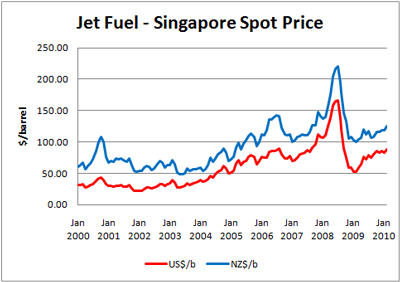


Again I have used monthly data from the Reserve Bank of New Zealand for the foreign exchange rates and from the US Energy Information Administration for the fuel spot prices.
Subscribe to:
Posts (Atom)


 Posts
Posts

